What is AI search optimisation (GEO)?
AI search optimisation, also called GEO or generative engine optimisation, is the work of getting your business named and cited in answers written by AI tools such as ChatGPT, Claude, Perplexity, Gemini, Microsoft Copilot and Google's AI Overviews and AI Mode. It is also known as AI SEO or AEO (answer engine optimisation). Buyers increasingly ask an AI tool for a shortlist before they open a search results page, and Google now shows an AI-written summary above many results. If your business is not in those answers, it is not on the shortlist.
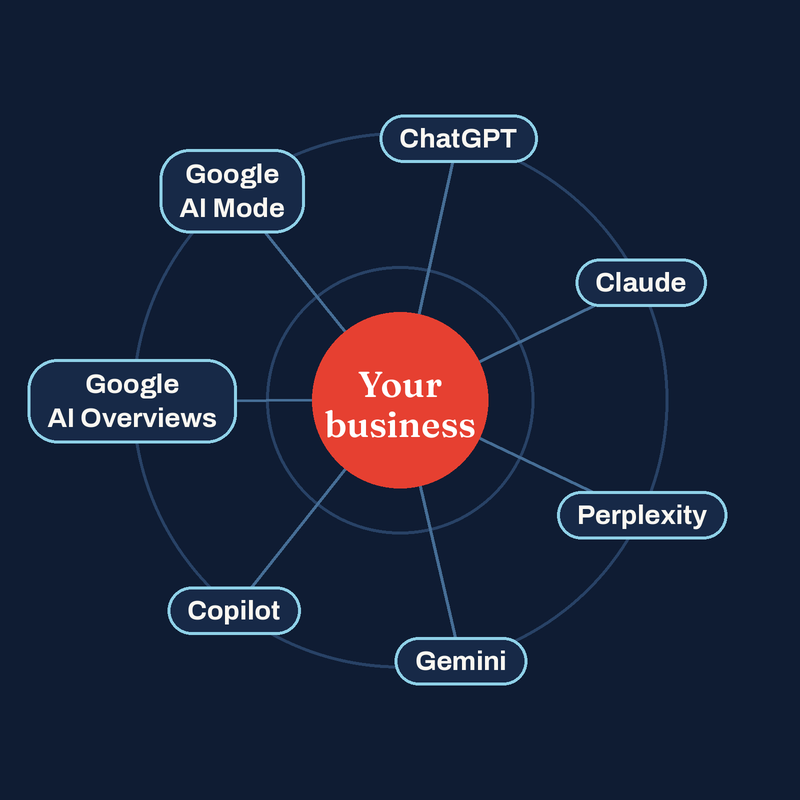
AI search optimisation across every major AI engine
Your buyers do not all use the same tool, so we test and track the ones that matter in your market: ChatGPT (including ChatGPT Search), Claude, Perplexity, Gemini, Microsoft Copilot, Google AI Overviews and AI Mode, Grok, Meta AI, DeepSeek and Mistral's Le Chat. The same fixes tend to help across all of them, but each engine names different businesses, so we measure each one separately.
GEO vs SEO
AI search optimisation does not replace SEO. AI engines lean heavily on pages that search engines already index and trust, so traditional SEO is the foundation and GEO is the layer on top.
| SEO | GEO | |
|---|---|---|
| Goal | Rank high in Google and Bing results | Be named and cited in AI-written answers |
| Where you appear | A list of links | Inside the answer itself, often with a link to your page |
| What decides it | Relevance, links, technical health | Clear, quotable pages, crawler access, consistent business details, mentions on other sites |
| How it's measured | Rankings, clicks, Search Console | How often you're named and cited for your buyers' questions, and your share of brand voice, per AI engine |
How AI search engines choose who to mention
When an AI tool answers a question, it pulls passages from web pages it can reach, writes an answer, and often cites its sources. Four things decide whether your pages get picked:
- Access: AI crawlers such as GPTBot, OAI-SearchBot, ClaudeBot and PerplexityBot have to be able to reach your site. Hosting, CDN and security settings can block them even when your robots.txt allows them.
- Clarity: pages that state plainly what you do, for whom, where and on what terms are easier to quote than vague marketing copy. Key facts belong in page text, not in images, and question-and-answer sections are easy for AI tools to lift.
- Consistency: your business name, location and services should match across your site, schema, directories and profiles.
- Mentions elsewhere: reviews, directory listings, press, partner sites and community sites such as Reddit show AI engines that others vouch for you. Much of what an AI tool cites comes from sites you do not own.
How we measure AI search optimisation results
Rankings and clicks do not show whether an AI tool names you, so we track different numbers, for each AI engine and against your named competitors:
- Mentions: how often your business is named for your buyers' questions.
- Citations: how often your pages are linked as a source.
- Share of brand voice: your mentions as a share of all the brands named in those answers.
- Position: where in the answer you appear.
We set a baseline in the audit and re-run the same questions every month, so you see movement against a fixed starting point.
What we check in an AI search optimisation and SEO audit
- Your buyers' real questions, run through ChatGPT, Claude, Perplexity, Gemini, Copilot, Google AI Overviews and AI Mode
- Which competitors get named instead of you, and why
- Your mentions, citations and share of brand voice in each engine
- AI crawler access at every layer: robots.txt, hosting, CDN and security plugins
- Indexing and technical SEO: Search Console, sitemaps, speed and mobile
- Structured data and consistency of your business details
- Content gaps: questions your buyers ask that no page of yours answers
- Mentions on directories, review sites, press and communities
You get a ranked list of fixes, starting with the ones that move results fastest.
How an engagement runs
- Call: you tell us your business, your buyers and the questions they ask.
- Audit: we test where you stand today and rank the fixes.
- Setup: our engineers implement the fixes on your site and across your listings.
- Monthly: we add content, track where you appear and report back.
AI search optimisation results
Small B2B and B2C clients of ours have gone from no appearance in LLM search results to making LLM search a top-of-funnel sales channel. Another client reached 30% of brand voice in under 12 weeks. Results depend on your market and where you start, and nobody can promise what an AI tool will say.
We're close to the end of three months with Vekt and the results have been outstanding: our visibility across the LLMs has increased dramatically off the back of their work.
Client, AI visibility engagement
GEO for B2C and B2B businesses
We have delivered audits, setup and monthly work for both consumer and business-to-business clients. The work differs by audience. Consumer businesses usually need to appear for local, comparison and "best near me" questions. B2B firms need to appear when a buyer asks an AI tool to compare suppliers or explain the problem your service solves.
Why VEKT AI
Most AI search optimisation is sold by marketing and SEO agencies. We come at it from the engineering side. Our team includes ex-Google engineers, and our founder led product teams at Google for more than 15 years. We also build AI agents for clients, so we work every day with how language models find, read and quote content. And we make the technical fixes ourselves, from crawler access to structured data and page code, rather than handing a list to your developer. We work with clients in Ireland, the UK and worldwide.
If you use AI in your own products or customer service, the EU AI Act may apply to you too. We can cover that in the same conversation.